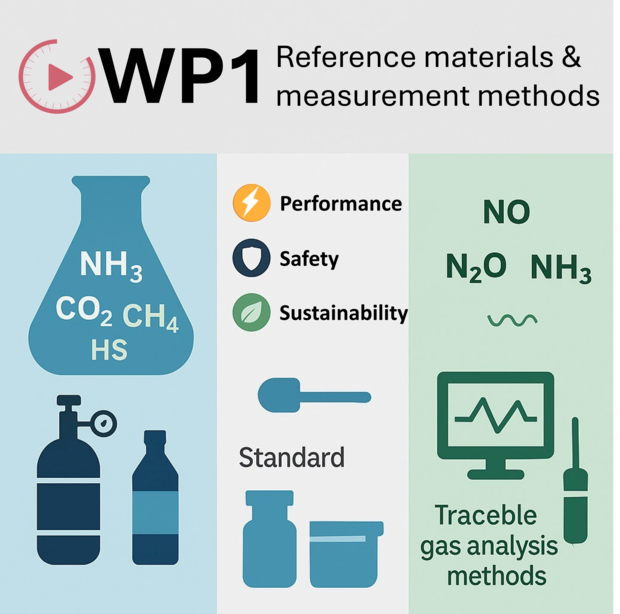
WP1: Reference Materials & Measurement Methods
Lead by Matthias Richter | Bundesanstalt für Materialforschung und -prüfung
In the transition towards a sustainable energy future, ammonia is gaining attention as a clean energy carrier. But to unlock its potential, we must ensure reliable and traceable measurements of its quality across the entire value chain – from production to conversion.
Why quality matters:
✅ Performance: Purity directly impacts energy content and thermal conversion efficiency.
✅ Safety: Even trace amounts of corrosive or reactive impurities can damage tanks, pipelines, and fuel systems.
✅ Sustainability: Leakage and emissions (NOₓ, N₂O, ammonia slip) affect both environmental and human health.
WP1 in action:
🔹 Task 1.1 – Streamlining emerging industry requirements. (Lead by Robert Steinberger-Wilckens | University of Birmingham)
🔹 Task 1.2 – Reference materials and traceable gas analysis methods for impurities in an ammonia matrix. (Lead by Matthias Richter | Bundesanstalt für Materialforschung und -prüfung)
🔹 Task 1.3 – Development of traceable gas analysis methods/reference materials for priority air pollutants. (Lead by Tatiana Macé | LNE)
By establishing metrological tools for ammonia quality control and emission monitoring, WP1 is laying the foundation for safe, efficient, and sustainable ammonia-based energy systems.
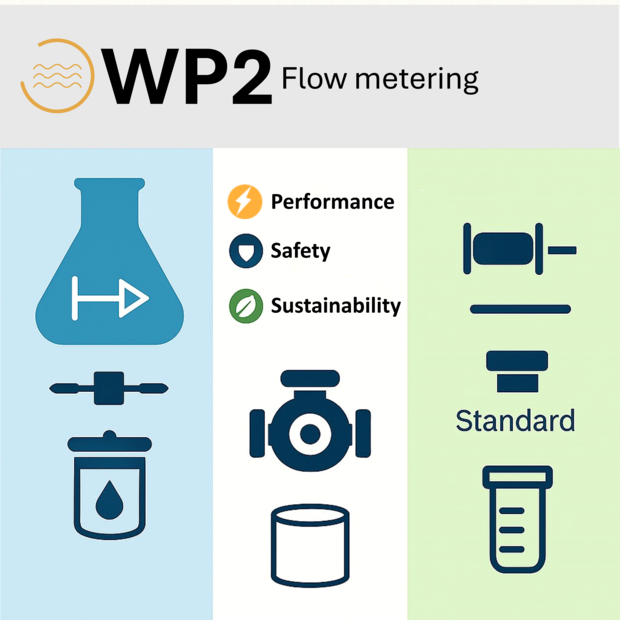
WP2: Gas & Liquid Flow Measurements
Lead by Marcel Workamp | VSL National Metrology Institute
As ammonia transitions from an industrial feedstock to a carbon-free energy carrier, one of the key challenges is ensuring accurate flow measurement for both its liquid and gaseous states.
Why it matters:
Current tank-level measurements lack the accuracy needed for custody transfer of fuels, while commercial flow meters are typically calibrated with surrogate fluids (air, water, nitrogen) instead of ammonia itself. With no ammonia flow calibration facilities currently available, reliable measurement methods must be established.
WP2 in action:
🔹 Task 2.1 – Reviewing and defining metrological needs, ranges, surrogate fluids, and calibration methods. (Lead: TÜV SÜD)
🔹 Task 2.2 – Advancing gaseous ammonia flow metering solutions. (Lead: VSL National Metrology Institute)
🔹 Task 2.3 – Developing liquid ammonia flow metering approaches and assessing surrogate fluids. (Lead: Justervesenet)
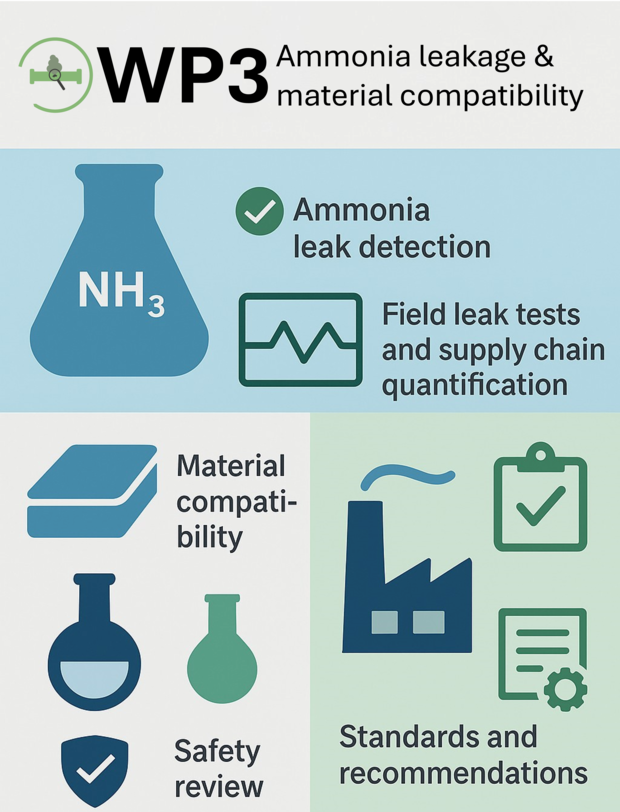
WP3: Leakage & Material Compatibility
Lead by Jan Conrad Petersen | DFM - Danish National Metrology Institute
As the energy sector moves toward ammonia as a sustainable energy carrier, ensuring safety and reliability becomes paramount. This work package focuses on providing the metrological support needed for ammonia leakage detection and material compatibility.
WP3 in action:
🔹 Task 3.1: Develop and support robust ammonia leak detection methods. (Lead: Universidade Nova de Lisboa)
🔹 Task 3.2: Perform field leak tests with controlled releases to quantify leaks across the supply chain. (Lead: Instytut Nafty i Gazu - Państwowy Instytut Badawczy)
🔹 Task 3.3: Study material compatibility, focusing on degradation mechanisms. (Lead: OWI Science for Fuels gGmbH)
🔹 Task 3.4: Assess sensor degradation, adsorption/desorption effects, and conduct a comprehensive safety review of ammonia handling. (Lead: OWI Science for Fuels gGmbH)
The outcomes of WP3 will strengthen industry capability to work safely with ammonia, while supporting regulatory authorities in ensuring that emerging ammonia infrastructures meet the same safety levels as today’s energy systems.
WP4: Real-time emission measurement techniques and ammonia life-cycle analysis
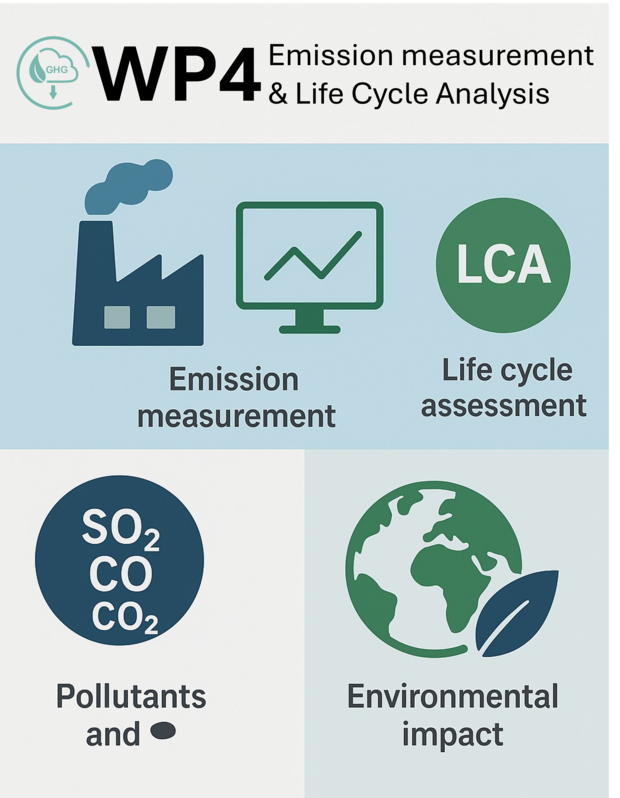
Lead by Alexander Fateev | DTU - Technical University of Denmark)
Shaping a Cleaner Energy Future with Ammonia. At MetNH3Energy, we’re tackling a big question: How can ammonia power our world sustainably without harming the environment?
Work Package 4 is all about making this possible by:
✅ Developing real-time emission monitoring for key gases like NH₃, N₂O, NO, and NO₂.
✅ Performing life-cycle assessments (LCA) to ensure ammonia-based energy systems are truly green.
WP4 in action:
🔹 Task 4.1: Develop, characterize, and validate robust real-time measurement techniques.(Lead DTU - Technical University of Denmark)
🔹 Task 4.2: Field tests of real-time online emission monitoring techniques. (Lead LEC GmbH)
🔹 Task 4.3: NH3 ex-ante techno-economic and environmental LCA. (Lead Delft University of Technology)
WP5: Creating Impact
The outcomes of this project will be widley spread through the webpage, social media platforms, several papers and presentation on different conferences. The consortium is also planning several workshops to project related topics, which will be announced through the webpage. Creating impact within this project will support all relevant stakeholders from industry, manufacturers, standardisation committees, metrology institutes and the scientific community.