MetNH3Energy highlights the role of metrology in ammonia-based fuel combustion alongside MetZeroPol and MetNH3Energy projects
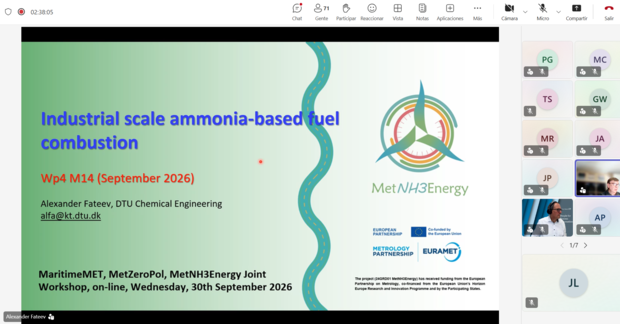
The MetNH3Energy project took centre stage to discuss ammonia-based fuels during the MaritimeMET, MetZeroPol and MetNH3Energy Joint Workshop, held online on 30 September 2026 under the theme “Sector-Specific Approaches to Emission Monitoring.” The workshop brought together researchers and industry experts to explore the measurement challenges associated with emissions from different sectors and technologies. MetNH3Energy contributed to the event by presenting its work on industrial-scale ammonia-based fuel combustion, highlighting the importance of reliable emission monitoring as ammonia emerges as an alternative fuel for the energy transition.
MaritimeMET addressed the characterisation of low-cost sensors through laser spectroscopic methods with Javis Nwaboh, Research Scientist at the German National Metrology Institute. The programme also included invited speakers Sotiris Topaloglou, Deputy VP R&D and Global Head of Testing & Validation at WinGD Ltd, and Gabrielle Pisetta, Test Engineer at WinGD Ltd, who brought an engine manufacturer's perspective to emissions associated with methanol and ammonia as alternative fuels.
The second project featured in the workshop, MetZeroPol, focused on measuring PFAS (per- and polyfluoroalkyl substances) in industrial emissions, presented by Christian Vogel, Senior Scientist at the German Federal Institute for Materials Research and Testing (BAM). Lighea Speziale, Founding Partner and Project Leader at Seeds Consulting, took part as an invited speaker and discussed the impact of the revised Industrial Emissions Directive and BAT (Best Available Techniques) Conclusions on industrial emissions.
Representing MetNH3Energy, Alexander Fateev, Senior Scientist in the Department of Chemical and Biochemical Engineering at the Technical University of Denmark (DTU), explored the project’s work on ammonia-based fuel combustion at industrial scale. The project highlighted how ammonia is becoming part of a broader debate on alternative fuels, pointing to increasing measurement capabilities to better control its emissions and, consequently, expand the use of ammonia. Then, Julian Edler, Development Engineer at the Innovation Lab of Endress+Hauser SICK GmbH (guest speaker), offered an industry perspective on the selection of technologies for monitoring nitric oxide, nitrogen dioxide, and ammonia.
Metrology can support the development and deployment of alternative fuels such as ammonia by providing reliable, traceable and fit-for-purpose emission measurements. For emerging technologies, robust measurement capabilities are essential to understand emission profiles, evaluate performance and support evidence-based decisions. In this context, MetNH3Energy’s focus on industrial-scale ammonia-based fuel combustion, together with the complementary perspectives presented by MaritimeMET and MetZeroPol, illustrates how measurement science can help connect technological innovation with reliable environmental data and contribute to the transition towards cleaner and more sustainable energy systems.
The slide deck and the webinar recording will be available soon.
MetNH3Energy explores the role of ammonia as an energy carrier at Webinar hold on the occasion of the World Maritime Day
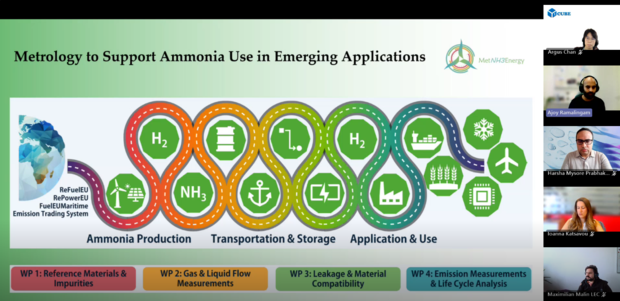
MetNH3Energy joined the World Maritime Day last Wednesday, September 24, taking part in the Virtual Tech Forum “From Policy to Practice: Powering Maritime Excellence” webinar, organised by 1 Cube BV. Ajoy Ramalingam, Postdoctoral Researcher at the German National Metrology Institute, showcased MetNH3Energy’s work on developing reliable measurements and standards to support the safe, efficient and trusted use of ammonia as an energy carrier.
The presentation focused on how the project addresses the measurement requirements across the ammonia value chain, from production to application. Ramalingam explained the main areas the MetNH3Energy is working on: measuring impurities and establishing reference materials, developing traceable gas and liquid ammonia flow measurements, addressing ammonia leakage detection and material compatibility, and improving emission measurements.
The webinar continued with a roundtable discussion bringing together experts from several European research and innovation projects to explore how maritime policies, decarbonisation targets and technological developments can be translated into practical solutions and real-world deployment. The panel brought together Fausto Gallucci, Senior Consultant at 1 Cube BV, representing APOLO; George Skevis, General Manager at CLEOS, representing CAIPIRINH3A; and Harsha Mysore, Innovation Consultant at BlueXPRT, representing Green Marine. Ajoy Ramalingam, who also took part in the discussion, represented MetNH3Energy.
The discussion provided a broader perspective on the conditions needed for ammonia to become a viable option for maritime decarbonisation. Participants considered the challenges of using ammonia in new vessels and retrofitting existing fleets, highlighting safety, fuel availability, bunkering infrastructure and the maturity of the technology as important factors. The discussion also stressed that there is unlikely to be a single solution for all maritime applications, with ammonia, methanol, carbon capture and other low-carbon options potentially playing different roles.
By developing reliable, traceable ammonia measurement capabilities, MetNH3Energy addresses practical requirements for the safe and efficient deployment of emerging maritime energy technologies.
MetNH3Energy presents results from the ISO 6143 comparative calibration method for NH₃ at EFCH2
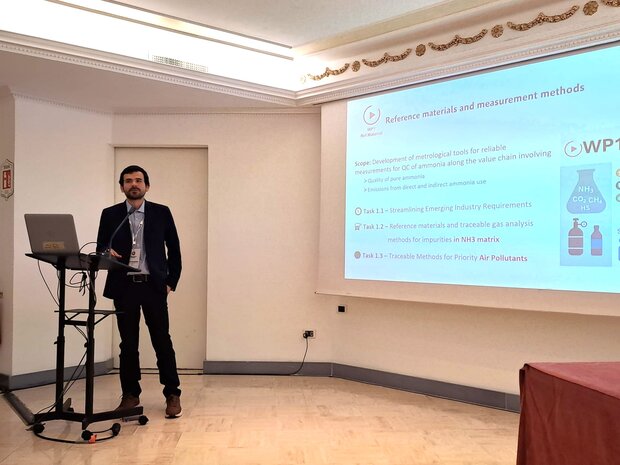
MetNH3Energy showcased the main updates on research regarding traceable ammonia measurements at European Fuel Cells and Hydrogen – Piero Lunghi Conference 2026 (EFCH₂ 2026) last September 16 in Capri, Italy. Miguel Ballesteros, Project Delivery Manager at GERG - The European Gas Research Group, outlined the interim results of the ISO 6143 validation as a calibration method for ammonia reference gas mixtures.
The Portuguese Institute for Quality (IPQ) led this research to develop traceable ammonia measurements. IPQ used the ISO 6143 comparative calibration method, which compares instrument responses with certified reference standards to establish a traceable calibration function. The validation was carried out at three ammonia concentration levels: 25, 503 and 1,001 µmol/mol. Each reference standard was measured over three consecutive days to assess both the accuracy and consistency of the method.
The results showed that the ISO 6143 comparative calibration procedure is robust and stable. For all three ammonia concentrations, the normalised error remained within the acceptance criterion of |En| ≤ 1, confirming the statistical compatibility of the measurements with the certified values. Moreover, the variations observed were small compared with the overall calibration uncertainty, confirming that the measurement process was stable and well controlled.
The work at IPQ could be extended to lower ammonia concentrations, between 5 and 30 µmol/mol. An intercomparison with other European laboratories is also envisaged, to demonstrate that laboratories can achieve comparable results using the developed approaches.
Through this work, MetNH3Energy is helping to ensure that ammonia measurements can be compared and traced back to recognised standards. The results will contribute to the wider objective of the project: providing a reliable basis for measurements across the ammonia value chain for future hydrogen and clean-energy uptake.

1st Press Release of MetNH3Energy
The EU-funded project MetNH3Energy launches its press release announcing the start of the project. In this press release, the project explains briefly but clearly the project's objectives, which aim to unlock the full potential of ammonia as a hydrogen energy carrier. In addition, we also analyse the positive outcomes that the project will have for industry, the metrology community, the economy, and the environment. Last, you can also learn about the partners involved in this project and their roles at MetNH3Energy. Read the full press release by clicking here to learn more about the project, our objectives, and expected impact.
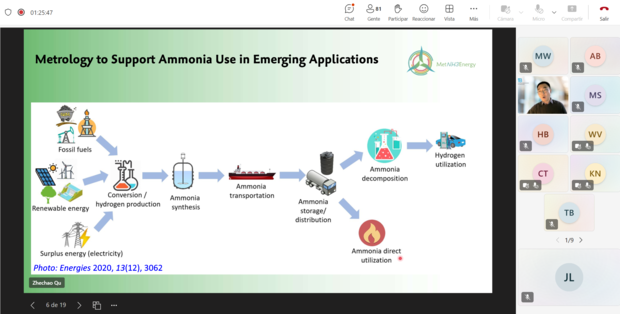
MetNH3Energy is presented at the EMN for Energy Gases Webinar 2025
MetNH3Energy was presented last Tuesday, October 28, in the European Metrology Networks for Energy Gases Webinar on New Research Projects 2025, organised by the European Association of National Metrology Institutes. This has been the first-ever presentation of the event in an event open to the public, where more than 80 stakeholders gathered to have a closer view of the project.
Zhechao Qu, our project coordinator and Project Scientist at the National Metrology Institute of Germany, delivered a presentation reviewing the goals of the project and the steps to be taken until the end of the project (July 2028). The presentation explained the details of this project that seeks to foster the use of ammonia as a hydrogen carrier, filling the gaps in the present infrastructure to enable a greater use and, eventually, boosting the entire hydrogen chain by enhancing ammonia trade.
Apart from our project, the webinar agenda was also filled with similar initiatives: CryoMet (Metrology for Reliable Liquified Energy Gases Measurement), SmartGasNet (Metrology for smart metering in gas networks) and MetroHyVe 3 (Metrology for Hydrogen Vehicles 3). After a short introduction of the EMN for Energy Gases by chair Annarita Baldan, the coordinators of these projects (Menne Schakel for CryoMet, Adriaan van der Veen for SmartGasNet & Thomas Bacquart for MetroHyVe 3) described how their projects help achieve the energy transition and presented their ambitious plans.
Past Events
Stakeholder Survey II - Ammonia Flow Measurement
The second part of our survey is now open to our stakeholders and all people intrested in and working with ammonia:
MetNH3Energy - Ammonia Flow Measurement Industry Needs & Requirements Survey – Fill out form
This survey aims to gather information on the needs, requirements, and current practices in ammonia flow metrology at present and those likely in 2035. Your insights will help inform the development of traceability chains and standards for ammonia flow measurement. All responses are valuable, and personal information is optional unless you wish to be contacted for follow-up.
Please feel free to share this link with your community.

1st Stakeholder Webinar

When: 14th of November 2025 from 10:00-12:00 am
Where: online
Stakeholder Survey part I
In preparation for the stakeholder meeting, we would like to invite you to participate in our short survey. Your responses will provide us with valuable insights and help us align our research with your needs. Part I of the survey will be open until November 24th.
Agenda
-
Introduction by Zhechao Qu (PTB)
-
Overview WP1 Reference Materials & Measurement Methods by Matthias Richter (BAM)
-
Overview WP2 Gas & Liquid Flow Measurements by Marcel Workamp (VSL)
-
Overview WP3 Leakage & Material Compatibility by Jan Conrad Peterson (DFM)
-
Overview WP4: Real-time emission measurement techniques and ammonia life-cycle analysis by Alexander Fateev (DTU)
-
„Ammonia Safety Project in Singapore and Possible Synergies with Metrology" by Shaik Samil (A*Star)
-
„Scaled Electrochemical Proton Ceramic Reactors for Hydrogen Technologies" by Gautier Papon (CoorsTek)
-
„Membrane reactors for ammonia decomposition – insights of APOLO project." by Fausto Gallucci (TU/e & 1CubeBV)
Project Kick-Off Meeting

The project kick-off meeting with all consortium partners was held from 8th to 9th of September 2025 at Physikalisch-Technische Bundesanstalt (PTB) in Braunschweig.